
Darts Checkout Guide
Finishing a leg is one of the most important parts of darts. Whether you are trying to take out 40, 80, 100 or 170, choosing the right checkout route can make the difference between winning the leg and giving your opponent another chance.
On this page, you’ll learn how darts checkouts work, how to choose better checkout routes and how your favourite double can influence the way you finish a leg. DartCounter also includes checkout suggestions directly in the app, so you can see recommended routes while playing. You can also set your favourite double in DartCounter, allowing the app to suggest checkout routes that better match the way you play.
What is a checkout in darts?
A checkout in darts is the score you need to finish a leg. In most popular darts formats, such as 501 or 301, you need to reach exactly zero and your final dart must land in a double or the bullseye.
For example, if you have 40 points left, you can finish the leg by hitting double 20. If you have 32 left, double 16 is the finish. The double segments are located in the outer ring of the dartboard. These are simple examples, but checkout routes become more important when you have higher scores left and need to use two or three darts to finish.
A good checkout route helps you plan your visit. Instead of only thinking about the first dart, you should think about the full route towards a double you are confident on.
How do darts checkouts work?
In darts, each visit gives you up to three darts. To complete a checkout, your final dart must leave your score on exactly zero and must land in a double segment or the bullseye.
That means not every score can be finished in one visit. The highest possible checkout is 170, which is finished with treble 20, treble 20 and bullseye. Scores above 170 cannot be checked out in three darts.
Some scores are also known as bogey numbers. These are scores below 170 that cannot be finished in three darts, such as 169, 168, 166, 165, 163, 162 and 159. Good players try to avoid leaving these scores because they cannot finish them in their next visit.
Understanding checkouts is not only about knowing which numbers to hit. It is also about leaving yourself a finish that fits your game.
Why checkout routes matter
A checkout route is the path you choose to finish a leg. For example, if you have 80 points left, one common route is treble 20 followed by double 10. But that is not the only option. Another player might prefer a route that leaves double 16, depending on their favourite double and confidence level.
The best checkout route is not always the same for every player. Some players prefer double 20, while others feel more comfortable on double 16, double 10 or double 8. Your preferred double can change the route you choose.
This is why learning checkout routes is valuable. It helps you make better decisions under pressure and gives you a clearer plan before you throw your first dart.
Checkout routes in the DartCounter app
DartCounter helps you find the right checkout route while you play. Instead of memorising every possible finish, you can use the app to see which route is recommended for the score you have left.
You can also set your favourite double in DartCounter. This allows the app to suggest checkout routes that better fit your own game. For example, if you prefer double 16, your checkout routes can be adjusted towards finishes that leave double 16 more often.
This makes checkout guidance more personal. A standard checkout chart can show a common route, but DartCounter helps you play towards the doubles you feel most confident on.
Want a checkout route that fits your game?
Use the DartCounter checkout calculator or set your favourite double in the DartCounter app to find routes that match the way you play.
Try the Checkout Calculator
Use a darts checkout chart
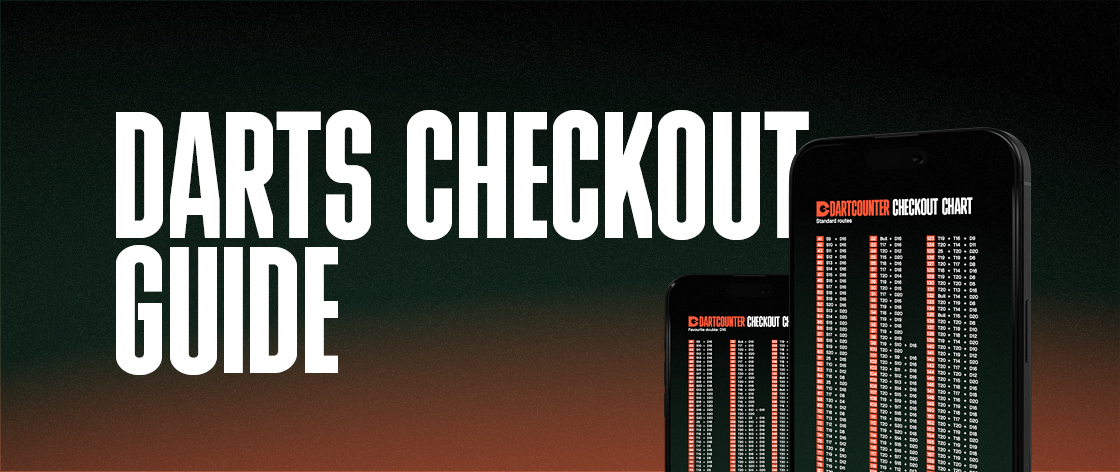
A darts checkout chart shows the recommended route for each score that can be finished. It helps you quickly see which numbers to aim for and which double you are trying to leave.
Checkout charts are especially useful for beginners and intermediate players who are still learning the most common finishes. Instead of guessing during a match, you can use a chart to understand the logic behind each route.
DartCounter offers a checkout chart that allows you to look up the recommended route for a specific score. This makes it easier to find the right finish while practising, playing at home or preparing for matches.
Find the best checkout route for your favourite double
Many darts players have a favourite double. For some players, that is double 20. For others, it might be double 16, double 10 or double 8. Your favourite double matters because it can influence the best route towards a finish. A standard checkout chart may show one recommended route, but that route might not always be the best option for your personal game.
In the DartCounter app, you can set your favourite double so checkout suggestions better match the way you play. If you prefer double 16, you may want to choose routes that leave 32 more often. If you are more confident on double 20, leaving 40 may be the better option.
The right route depends on your score, your skill level and the double you trust the most. DartCounter’s checkout calculator is designed to help with this. By entering your remaining score and selecting your preferred double, you can find a checkout route that better matches the way you play.
How to choose the right checkout route
Choosing the right checkout route depends on more than the score you have left. It also depends on your strengths, your confidence and the situation in the leg.
A good checkout route should help you leave a double you are comfortable with. If you are strong on double 16, it can make sense to choose routes that leave 32. If you are strong on double 20, you may prefer routes that leave 40.
It is also important to think about what happens if you miss. Some routes give you a better backup option than others. For example, many players like leaving 32 because double 16 gives you a long and simple fallback route: D16, D8, D4, D2 and D1. If you miss inside on D16, you leave 16. If you miss inside again on D8, you leave 8, and so on.
Double 20 also gives you follow-up doubles when you miss inside, such as D10 and D5. However, the D16 route is often seen as more forgiving because it gives you a longer sequence of clean halving options.
Beginners do not always need to copy professional checkout routes. A professional route may be mathematically strong, but that does not automatically make it the best route for your level. The best route is often the one that gives you the highest chance of finishing the leg.
Practice your checkouts with DartCounter
Learning checkout routes is useful, but improving your finishing also takes practice. The more often you practise checkouts, the faster you recognise routes during a match.
DartCounter helps players track scores, play matches and improve their darts performance. Checkout suggestions are included directly in the app, so you can see recommended routes while playing. You can also set your favourite double, allowing DartCounter to suggest routes that better fit your own finishing style.
Instead of only memorising numbers from a chart, you can make checkouts part of your regular practice routine. Over time, this helps you understand your own game, improve your decision-making and become more confident when finishing legs under pressure.
Want to improve your finishing?
Use DartCounter to practise your checkouts, set your favourite double and become more confident on your finishes.
Put your checkout knowledge into practice
Use DartCounter to practise finishes, track your checkout percentage and improve your decision-making under pressure.