
Darts Rules
Darts rules: how to play darts for beginners
Darts is easy to start playing, but knowing the basic rules makes every game clearer and more enjoyable. Beginners need to understand how points are scored, where to stand, when a dart counts and how a player wins a leg.
The most common darts game is 501. Each player starts with 501 points and takes turns throwing up to three darts. The points scored during each turn are subtracted from the remaining total. The first player to reach exactly zero with a valid finishing dart wins the leg.
This guide explains the basic darts rules, including dartboard scoring, turns, legs, sets, busts and checkouts.
What is the aim of darts?
The aim depends on the game being played. In 501, both players begin with 501 points and try to reduce their score to exactly zero before their opponent.
Players do this by throwing darts at the numbered sections of the board. The score from every valid turn is subtracted from the player’s remaining total.
Standard 501 normally uses the double-out rule. This means the final dart must land in a double segment or the inner bullseye. A player with 32 points remaining, for example, can win the leg by hitting double 16.
Other games, such as Cricket, Around the Clock and Bob’s 27, have different objectives. However, the basic rules around throwing, scoring and the dartboard remain largely the same.
How many darts do you throw per turn?
A player can throw a maximum of three darts during one turn. A turn is also commonly called a visit.
After the darts have been thrown, the total score is calculated and subtracted from the player’s remaining total. The opponent then takes their turn.
A visit can finish before all three darts have been used. This happens when the player completes the leg or goes bust. Any unused darts are not thrown once the visit has ended.
How scoring works on a dartboard
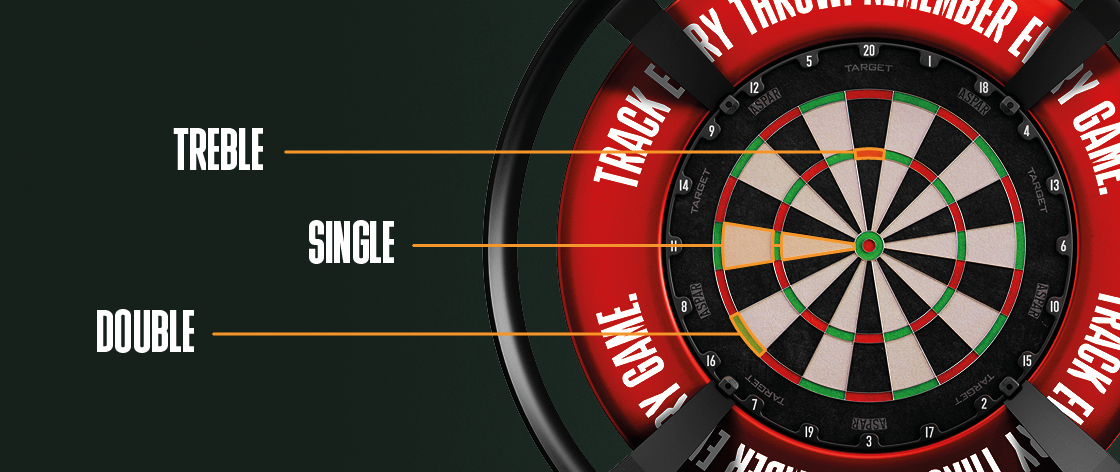
A standard dartboard contains 20 numbered sections. The numbers run from 1 to 20, but they are deliberately positioned in a non-sequential order around the board.
Most numbered sections contain two large single areas. Hitting one of these areas scores the number shown. The thin outer ring is the double ring and scores twice the value of the number. The thin inner ring is the treble ring and scores three times its value.
A dart in single 20 therefore scores 20 points. Double 20 scores 40 points, while treble 20 scores 60 points.
The centre of the board contains the outer bull and the inner bullseye. The outer bull scores 25 points. The bullseye scores 50 and can also be used as a finishing double.
The highest possible score with one dart is 60. The highest possible score during a three-dart visit is 180, achieved by hitting treble 20 three times.
When does a dart count?
A dart normally scores when its point remains in or touches the surface of the dartboard until the score has been confirmed.
A dart that misses the board, bounces out or falls out before the score is recorded scores zero. It still counts as one of the player’s three darts and cannot be thrown again.
Players should leave their darts in the board until the score has been checked and entered. Removing them too early can make it impossible to verify which sections were hit.
Electronic soft-tip dartboards may apply different rules. Some machines record the detected segment even when the dart falls out, so players should check the machine or competition settings before starting.
Where do you stand when throwing darts?
Players must throw from behind the oche. The oche is the line that marks the correct throwing distance from the dartboard.
A player’s foot may touch the oche, but it cannot touch the floor beyond its front edge during the throw. Leaning forward is allowed, provided the feet remain behind the line.
For a standard steel-tip setup, the centre of the bullseye is positioned 1.73 metres above the floor. The horizontal distance from the face of the dartboard to the oche is 2.37 metres. The diagonal measurement from the bullseye to the oche is approximately 2.93 metres.
Soft-tip dartboards can use different measurements. The complete <a href="/dartboard-height-distance">dartboard height and distance guide</a> explains how to measure and install a dartboard correctly.
Basic 501 darts rules
In a standard game of 501, every player begins with 501 points. Players take turns throwing up to three darts and subtract the score of each visit from their remaining total.
If a player starts on 501 and scores 60, the remaining score becomes 441. After the opponent completes their visit, the first player throws again.
The game continues until one player reaches exactly zero with a valid finishing dart. Under the standard double-out rule, the final dart must land in a double segment or the bullseye.
Some casual games use straight out, where the final dart can land in any scoring section. Double out, however, is the standard format in most organised and competitive games of 501.
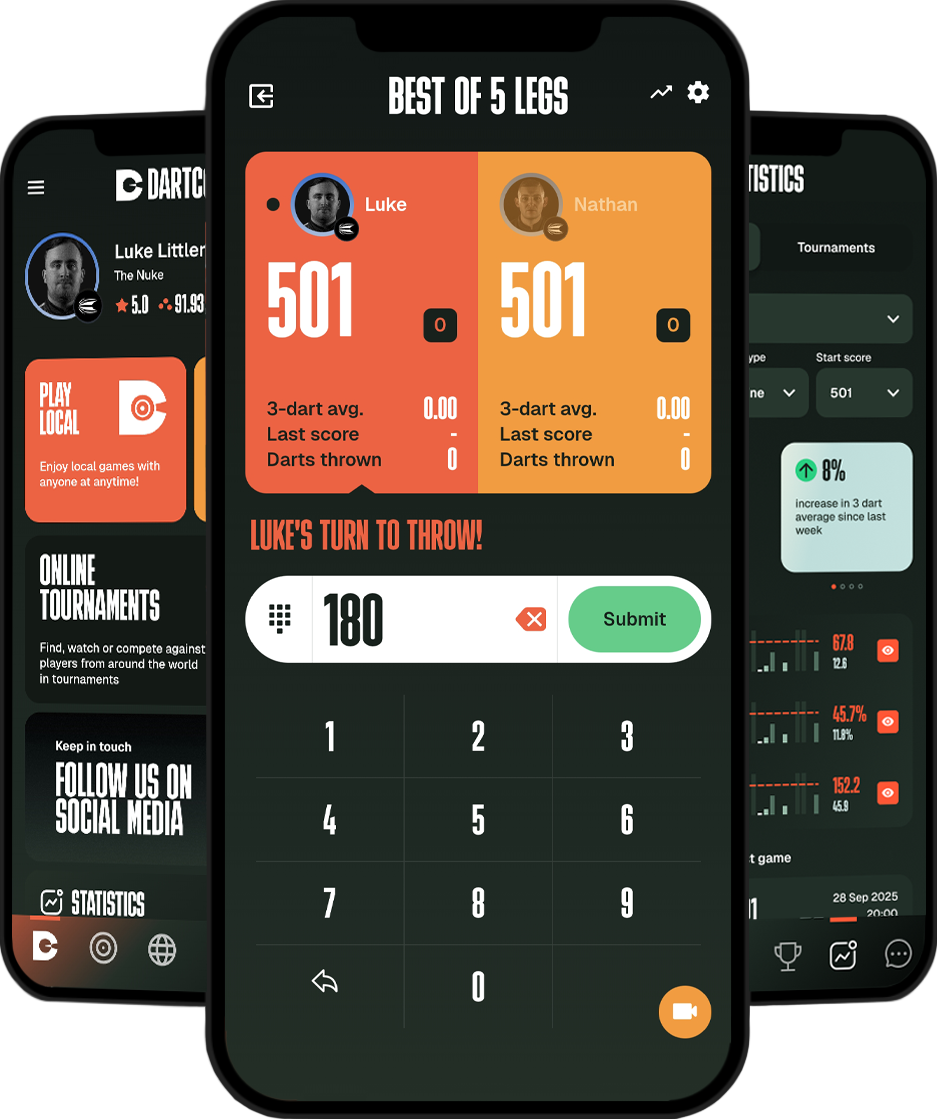
How DartCounter records your score
DartCounter calculates and records scores during a game. Once the thrown darts have been entered, the app updates the remaining total and stores information about the visit.
The scoring screen can show the current score, the latest visit, the individual darts thrown, the three-dart average and the first-nine average.
The three-dart average indicates how many points a player scores per visit on average. The first-nine average focuses on the first nine darts of each leg and provides insight into early scoring performance.
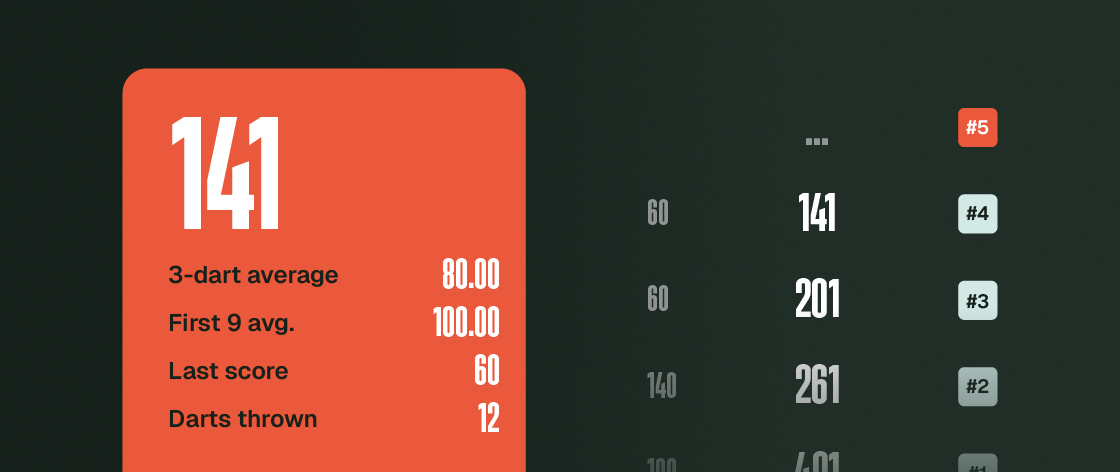
Using a scoring application reduces calculation errors and allows beginners to focus on throwing. At the same time, seeing the remaining score update after every turn helps players learn how scoring works.
What is a leg in darts?
A leg is one complete game of darts. In 501, both players start on 501 and try to reduce their score to exactly zero.
The first player to complete a valid finish wins the leg. The scores are reset before the next leg begins.
A match can consist of one leg or several legs. The required number of leg wins depends on the selected match format.
What is a set in darts?
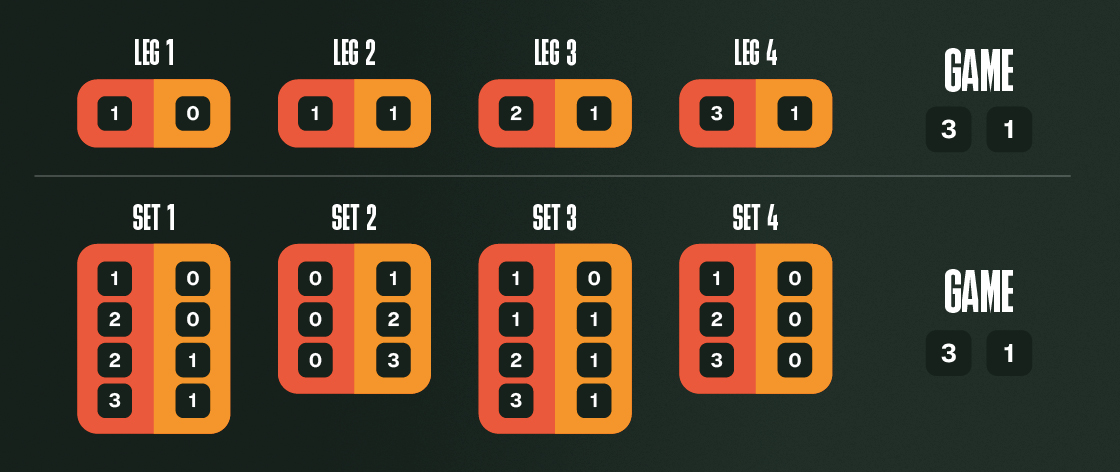
A set is a group of legs. Players first compete to win the required number of legs within a set. They then try to win enough sets to complete the match.
For example, a set may be played as best of five legs. The first player to win three legs wins that set. If the overall match is best of five sets, the first player to win three sets wins the match.
Not every competition uses sets. Some matches are played entirely over a fixed number of legs.
Set play gives players more opportunities to recover. A player can lose a leg and still win the set. They can also lose a complete set and still come back to win the match.
What does best of mean in darts?
The term “best of” indicates the maximum number of legs or sets that can be played.
A best-of-five-legs match is won by the first player to reach three legs. All five legs are only needed when the score reaches two legs each. If one player wins the first three legs, the match ends immediately.
A best-of-seven match is first to four. A best-of-eleven match is first to six.
Some matches are described as “first to” instead. A first-to-five-legs match has the same winning requirement as a best-of-nine-legs match.
For beginners, best of three or best of five legs is usually a suitable format. These matches provide enough opportunities to practise without becoming unnecessarily long.
What does double out mean?
Double out means that the final dart of a leg must land in a double segment or the inner bullseye.
The doubles are located in the thin outer ring of the dartboard. Double 16 scores 32 points, double 20 scores 40 and double 10 scores 20.
A player with 40 points remaining can complete the leg by hitting double 20. Hitting single 20 would only reduce the remaining score to 20.
The bullseye is also a valid double-out target. It scores 50 points and is treated as double 25.
Double out means that reaching zero is not enough by itself. The final dart must also land in a valid finishing section.
What does bust mean in darts?
A player goes bust when their visit creates an invalid remaining score under the double-out rules.
This happens when the score drops below zero, when the player leaves exactly one point or when they reach zero without finishing on a valid double.
When a player goes bust, the visit ends immediately. Their score returns to the total they had at the beginning of the turn.
Imagine a player starts a visit with 20 points remaining. Hitting double 10 wins the leg. Hitting single 20 reaches zero without a double and causes a bust. Hitting single 19 leaves one point, which is also a bust because no double scores one.
In both invalid situations, the player returns to 20 points for their next visit.
How checkouts work in darts
A checkout is the combination of darts used to complete a leg. Players must reduce their score to exactly zero, with the final dart landing in a double or the bullseye.
A player is generally considered to be on a checkout when the remaining score can be finished with three darts or fewer.
One possible route from 68 is to hit single 20, leaving 48. The player can then hit single 16 to leave 32 before finishing on double 16.
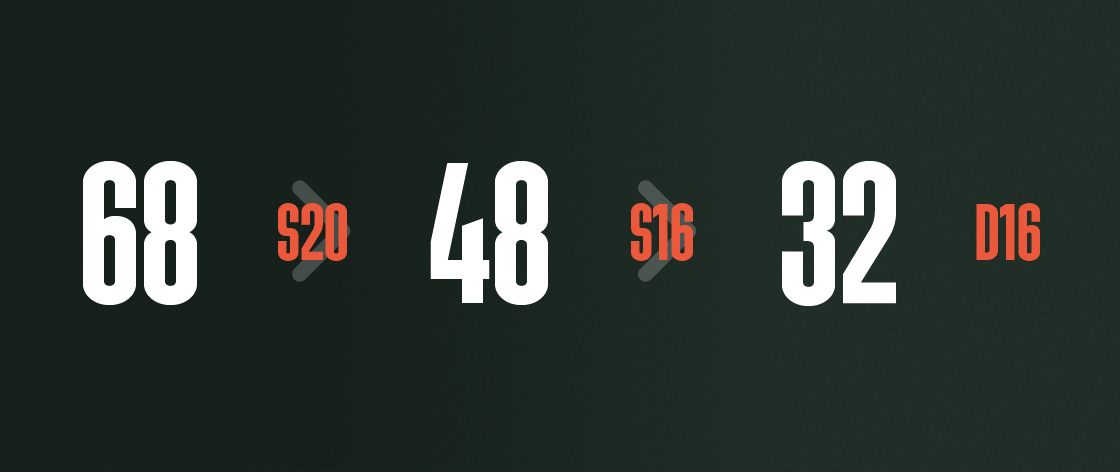
Double 16 is a popular finishing target. A dart that lands in single 16 leaves double 8, which can then be divided into double 4 and double 2 if necessary.
There are often several possible routes for the same score. The preferred option may depend on the player’s favourite doubles, the number of darts remaining and the opponent’s score.
The highest possible checkout in standard 501 is 170, completed with treble 20, treble 20 and the bullseye.
Not every score below 170 can be completed in three darts. Totals such as 169, 168, 166, 165, 163, 162 and 159 are known as bogey numbers because no valid three-dart route exists.
Beginners do not need to memorise every checkout immediately. It is usually more useful to learn common one-dart finishes such as double 20 from 40, double 16 from 32 and double 8 from 16.
Use the <a href="/checkout-calculator">checkout calculator</a> to find a route for your remaining score. The complete <a href="/darts-checkout-guide">darts checkout guide</a> explains finishes, setup shots and checkout strategy in more detail.
Who throws first?
Players often decide who starts by throwing one dart at the bullseye. This is commonly known as throwing for the bull.
The player whose dart lands closest to the centre starts the first leg. If both players hit the same part of the bull, they normally throw again.
In many formats, the starting player alternates between legs. If player one begins the first leg, player two starts the second.
Starting can be an advantage because that player has the first opportunity to complete a checkout. Winning a leg that you started is known as holding throw. Winning a leg started by the opponent is called breaking throw.
Tournament procedures can differ, so players should check the specific competition rules before playing.
Can you throw a dropped dart?
A dart that is accidentally dropped before a clear throwing action can normally be picked up and thrown.
Once a player has deliberately thrown a dart, it cannot be used again during that visit. This applies even when the dart misses the board, bounces out or falls to the floor.
In an official match, the referee may decide whether a dropped dart counted as a throwing attempt.
Common darts match formats
Darts matches can be organised in several ways.
A legs-only match ends when one player reaches the required number of leg wins. A best-of-eleven-legs match, for example, is won by the first player to win six legs.
A set format requires players to win legs within each set and then win the required number of sets.
In a knockout tournament, the winner advances to the next round and the loser is eliminated. In a group or round-robin format, each player competes against several opponents and receives points or a ranking based on the results.
For a casual game between beginners, a best-of-three or best-of-five match of 501 is generally the simplest option.
Basic darts rules summary
The basic rules of darts are straightforward. Players throw from behind the oche and can use up to three darts per visit. In 501, every player begins with 501 points and subtracts the score of each valid turn.
A dart normally only scores when it remains in the board until the score has been confirmed. Missed darts and bounce-outs score zero and cannot be thrown again.
To win a standard 501 leg, a player must reach exactly zero and finish on a double or the bullseye. Going below zero, leaving one point or finishing incorrectly causes a bust. The score then returns to the total at the start of the visit.
A leg is one complete game. A set consists of several legs. The player who wins the required number of legs or sets wins the match.
Once these rules are clear, beginners can start playing 501 and gradually learn more about checkout routes, scoring patterns and match strategy.
Practice darts with DartCounter
Track your scores, practise finishes and play your favourite darts games.