
Cricket/Tactics Game Rules
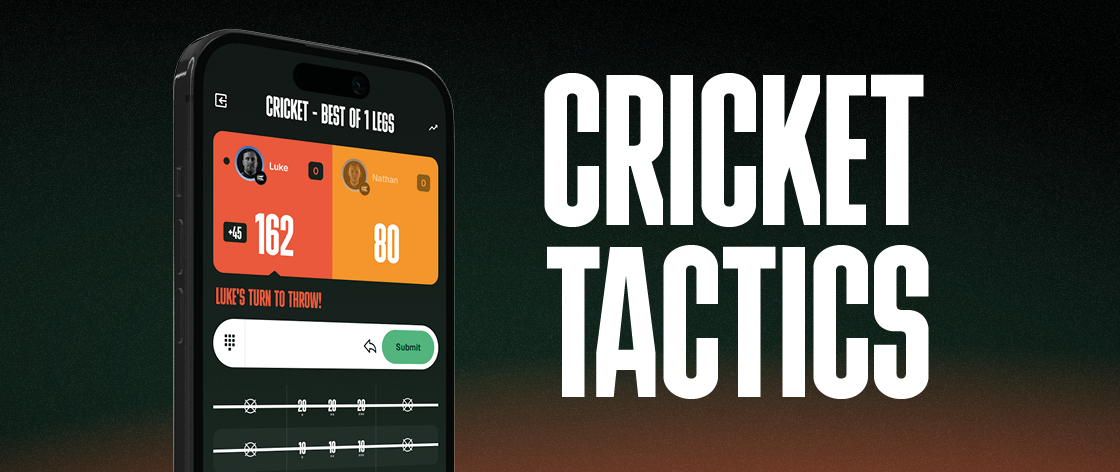
Cricket is one of the most tactical darts games. Instead of counting down from a starting score as you would in 501, you compete to close specific targets while deciding when to score points against your opponents.
Standard Cricket uses the numbers 15 through 20 and the bull. Each target must be hit three times to close it. Once you have closed a target that remains open for an opponent, you can continue hitting it to score points.
To win, you need to close all the required targets while having at least as many points as your opponent. This combination of closing, scoring and reacting to the situation on the board makes Cricket straightforward to learn but difficult to master.
How to play Cricket
The active targets in standard Cricket are:
15 → 16 → 17 → 18 → 19 → 20 and the bull.
Your first objective is to close each target by recording three marks. A single counts as one mark, a double as two and a treble as three.
For example, you can close 20 by hitting:
- three singles;
- one single and one double; or
- one treble.
Any combination is valid as long as it produces three marks. The bull follows the same principle. The outer bull counts as one mark and the bullseye counts as two marks.
Once you have recorded three marks on a target, that target is closed for you. You may then be able to use additional hits on the same target to score points.
For explanations of terms such as singles, doubles, trebles and bullseye, see our darts glossary. Our darts rules guide provides more information about turns, dartboard segments and general match play.
Cricket scoring
You can score points on a target after you have closed it, as long as at least one opponent still has that target open.
Every additional hit scores the numerical value of the target. On 20, for example:
- a single scores 20 points;
- a double scores 40 points;
- a treble scores 60 points.
Suppose you have already closed 20 but your opponent has only recorded two marks on it. As long as their 20 remains open, you can continue scoring points on that number.
Once your opponent records their third mark and closes 20 as well, neither player can score any more points on that target. This creates the central tactical decision in Cricket: should you close your remaining targets as quickly as possible, or use an open number to build a points advantage first?
Your best option can change after almost every visit.
How do you win in Cricket?
To win a standard game of Cricket, you must:
- close 15, 16, 17, 18, 19, 20 and the bull; and
- have at least as many points as your opponent.
Closing all your targets first therefore does not automatically end the game. If you have closed everything but are still behind on points, you need to keep scoring on targets that remain open for your opponent until you draw level on points or move ahead.
For example, imagine that you have closed every target but trail by 40 points. If your opponent still has 20 open, you can continue scoring on 20. A treble 20 would give you 60 points and move you into the lead.
The game rewards both accuracy and decision-making. Closing quickly removes scoring opportunities, while building a points advantage can give you additional protection later in the game.
Cricket vs Tactics
DartCounter also includes Tactics, an extended version of Cricket that uses more numbers on the dartboard. Both games use the same basic system of marks, closing targets and scoring points. The main difference is the number of active targets.
In standard Cricket, you work through six numbered targets plus the bull. Tactics adds 10, 11, 12, 13 and 14. This means more targets have to be closed and generally creates a longer game.
Because more of the dartboard is involved, Tactics can also challenge your accuracy outside the higher-scoring sections commonly targeted during regular match play.
Players looking for another game that takes them around different areas of the board can also try Around the Clock darts.
Play Cricket in DartCounter
Cricket can be played on your own, with other players or against the DartBot. Solo play gives you a way to practise closing targets and improve your average marks per round without needing another player.
Against other players, the tactical element becomes more important. Your preferred target can change depending on which numbers have already been closed and where each player stands on points.
You can also add the DartBot as an opponent. In Cricket, the DartBot's level determines how consistently it hits the required targets. This allows you to practise the normal competitive structure of Cricket even when another player is unavailable.
A Cricket game currently supports up to four participants. Human players can compete individually or in teams, and you can add a DartBot when you want a computer-controlled opponent.
Cricket match formats
Cricket matches in DartCounter can be played across multiple legs or sets. You can choose between a First to and Best of format.
With First to, the match ends when a player or team reaches the selected number of leg or set wins. With Best of, the selected number represents the maximum number of legs or sets that can be played. A Best of 5 Legs match, for example, is won by the first player to win three legs.
You can also enable a two-leg difference. When this setting is active, a player or team must move at least two legs ahead before the match can be won.
For a broader explanation of legs, sets and common match structures, read our darts rules guide.
Cut-Throat Cricket
Cut-Throat Cricket reverses the normal scoring objective. Instead of adding points to your own score, scoring on an open target gives penalty points to your opponents.
The objective is therefore to close all the required targets while finishing with the lowest score. This changes the strategy considerably. An open target gives you an opportunity to increase an opponent's score, while closing your own targets protects you from receiving additional penalty points on those sections.
Cut-Throat is particularly interesting with three or more players because a scoring visit can affect multiple opponents at the same time. Rather than simply trying to score as many points as possible, you need to consider who receives those points and how the current scores affect your position in the game.
Track your Cricket performance
After playing Cricket, DartCounter allows you to review your performance. One of the main Cricket statistics is your marks per round. This shows how many valid Cricket marks you record during an average three-dart turn.
A higher marks-per-round average generally means that you are closing targets more efficiently and creating more opportunities to score. Free users can review statistics from their most recent game. With DartCounter Ultimate, you can access your saved games, compare results across longer periods and view additional statistics.
Cricket statistics should always be considered alongside your tactical decisions.
A visit with fewer marks can still have a major impact if it closes an important number and removes an opponent's opportunity to continue scoring on it. Your numbers therefore show part of the story, while the match situation determines whether each decision was effective.
Play Cricket online
Cricket and Tactics can also be played online against another DartCounter player.
When creating an online match, select Cricket or Tactics as your game type and configure the match format. You can choose settings such as:
- legs or sets;
- First to or Best of;
- an optional two-leg difference; and
- the game timer.
You can also determine how quickly entered scores are shared during the match. When creating a game for the global lobby, join requirements allow you to decide which players can enter. Depending on your setup, you can require an Ultimate subscription, a camera, Omni Autoscoring, or either a camera or Omni.
Once the setup has been saved, other eligible players can find the match through the global lobby. Non-Ultimate players can play up to three online matches per week across DartCounter. With DartCounter Ultimate, online play is unlimited.
For a complete explanation of remote matches, cameras and the global lobby, read our guide to online darts with DartCounter.
Why play Cricket?
Cricket creates a different challenge from traditional x01 games such as 501 darts. In 501, every visit is primarily about reducing your remaining score, setting up a finish and eventually completing a checkout. Cricket requires you to monitor several targets at the same time, follow what your opponent has already closed and decide whether closing or scoring gives you the greater advantage.
That means the value of the same dart can change depending on the match situation. A treble 20 can close 20 immediately. Later in the game, the same treble could score 60 points. If your opponent has already closed 20, however, it may no longer help you at all.
Play smarter tactical darts
With Ultimate, you get more online play, deeper statistics and extra ways to review your performance in tactical games like Cricket and Tactics.
Explore Ultimate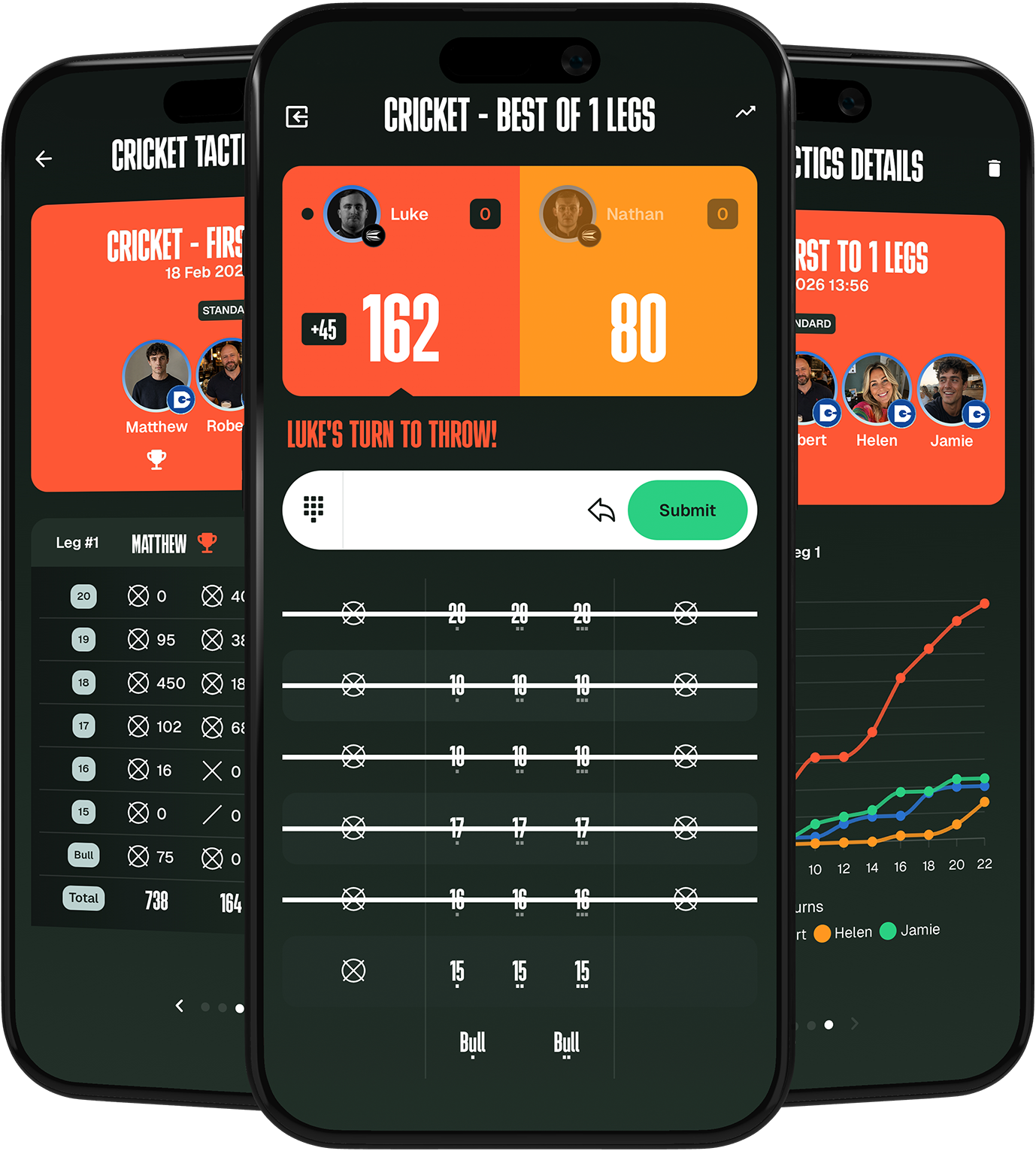
Explore more darts games